Over 50? The balance test you can do in your hallway that predicts fall risk in under 10 seconds
You stand up, feel a tiny wobble, grab the wall “just in case”, then tell yourself you were moving too fast. A simple test doing the rounds in physio clinics promises something more honest: in under 10 seconds, in your own hallway, you can get a rough sense of how likely you are to fall in the next few years.
No gym, no special gear, no Lycra. Just you, a sock drawer and a quiet bit of floor.
The 10‑second balance test a UK physio gives every new patient
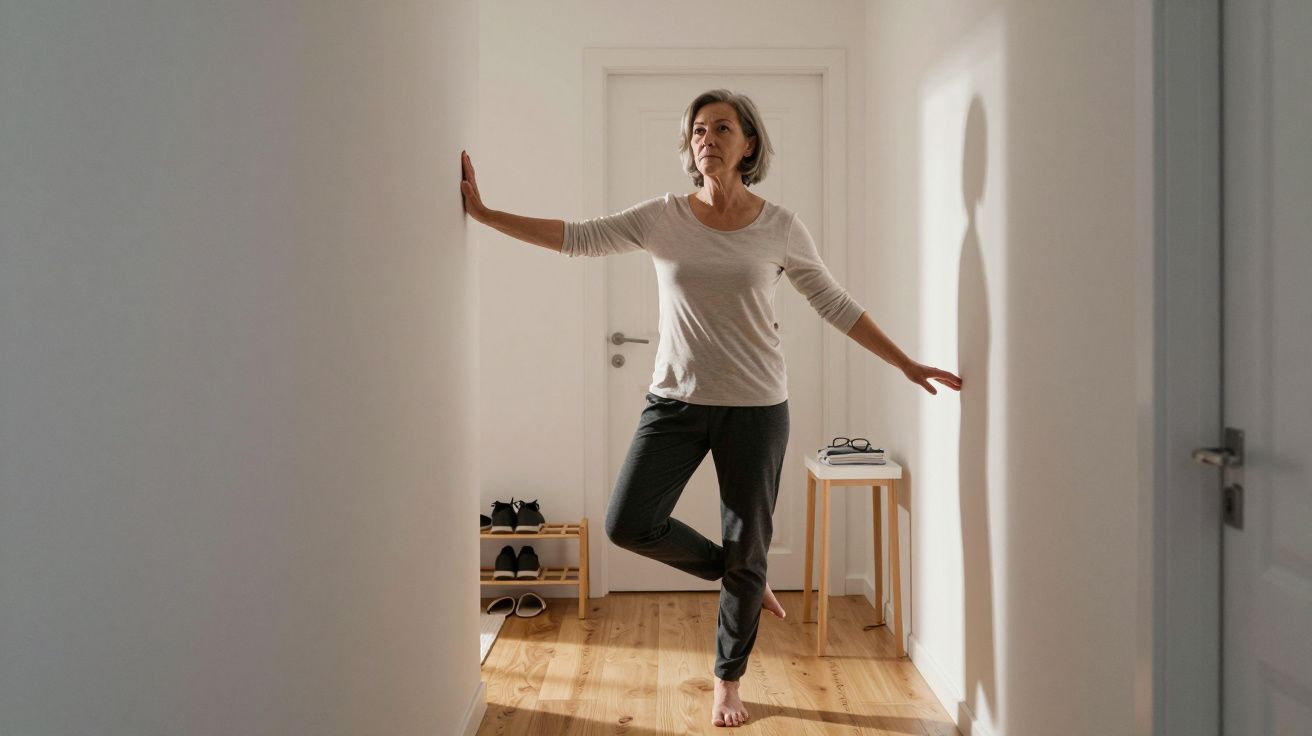
In a small clinic above a chemist in Manchester, people file in with sore knees, cranky hips and “just getting older” written all over their stories. Between questions about pain and sleep, the physio asks everyone over 50 to do one thing: stand on one leg, barefoot, for up to 10 seconds, without holding on.
He sets a timer, stands close enough to catch, and says the same three words: “Look straight ahead.”
It sounds almost childish, like something you’d do in the playground. Yet a growing body of research suggests that the ability to balance on one leg for around 10 seconds in later life is linked to lower risk of falls, fractures and even earlier death. It is not fate written in stone, but it is a useful red flag.
One retired engineer told me he laughed when he heard the instructions. “I thought I’d nail it,” he said. “I lasted three seconds before windmilling.” He went home with a short plan: tiny daily balance drills in the kitchen while the kettle boiled. Six weeks later he was up to 12 seconds, calm and steady.
Why this simple hallway test matters so much after 50
Most falls do not start with a dramatic trip. They start with a small stumble - a missed kerb, a turned head while walking, a slippery step out of the shower - and a nervous system that can’t react quickly enough to recover. Balance is your in‑built anti‑fall system. When it fades quietly, risk climbs.
Age itself is not the villain. Strength in your feet, ankles and hips, your vision, your inner ear, your reflexes and even your confidence all feed into balance. Long spells of sitting, certain medications and past injuries quietly erode it. The 10‑second test pulls all those threads together into one short, practical challenge.
Think of your balance like your smoke detector. Most of the time you ignore it. When it fails a basic check, you do not panic - you fix the batteries. A poor one‑leg score is not a prediction that you will definitely fall. It is a nudge to update the system while you can still walk into a clinic, not after you are wheeled into A&E with a fractured hip.
How to do the 10‑second one‑leg balance test at home
You do not need a physio in the room, but you do need a bit of common sense. Choose a quiet time of day when you are not rushed, dizzy or fresh from a drink.
Here’s the version many UK physios use with people over 50:
- Stand in a hallway or by a kitchen worktop, barefoot or in flat shoes, feet hip‑width apart.
- Place two fingers lightly on the wall or counter to get into position, then remove your hand.
- Lift one foot a few centimetres off the floor, knee slightly bent, keeping your standing leg straight but not locked.
- Look straight ahead, not at your feet, and start the timer as soon as you are fully on one leg with no support.
- Stop the timer when:
- your raised foot touches the floor;
- you grab for support; or
- your standing foot moves significantly.
Repeat up to three times on each leg and record your best time for each side. Always stand close to a support you can grab, and consider having someone with you the first time you try it, especially if you have already had a fall.
If you feel light‑headed, get chest pain, or your vision goes odd, sit down and speak to a health professional. This test should feel like steadiness work, not a near‑miss.
How to read your result (without scaring yourself)
Researchers and clinicians use slightly different cut‑offs, and your overall health matters, yet some broad guide rails help:
| Best time (each leg) | What it can suggest* |
|---|---|
| 0–3 seconds | Balance is limited; fall risk may be higher |
| 4–9 seconds | “Grey zone”; room to improve and worth training |
| 10+ seconds | Reassuring, but still worth keeping balance sharp |
*Not a diagnosis. A poor score is a prompt to seek personalised advice.
Pay attention to differences between legs too. If one side is clearly weaker or shakier, that leg is more likely to let you down during a stumble. Many people are surprised to find their non‑dominant leg outperforms their “good” side, often thanks to old injuries or stiff hips.
This is where a calm mindset matters. The point is not to “pass an exam”. The point is to get information early enough to act. A five‑second wobble today is easier to work on than a broken wrist next winter.
The 60‑second balance routine to build fall‑proof legs
The good news is that balance responds well to small, regular practice. We are talking minutes, not marathons.
Here is a 60‑second hallway routine a London physio gives to busy patients:
20 seconds: light fingertip balance
Stand on one leg, two fingers resting on the wall or worktop. Slowly reduce the pressure through your fingers but keep them there for safety. Breathe steadily.20 seconds: hands‑free hold
Hover your hands just above the surface without touching, same leg. Focus your eyes on a fixed spot ahead, not the floor.20 seconds: tiny movements
Still on one leg, gently turn your head left and right or reach one arm forwards and sideways, keeping the movement small and slow.
Switch legs and repeat if you feel fresh. If hands‑free feels too much, stay at the fingertip stage for a week or two. Progress is progress, even if it looks boring.
Key rules: no heroics, no pushing through dizziness, and always a firm support within grabbing distance. Tiny, controlled wobbles are how your body learns. Big, panicked ones are a sign to dial it back.
When to skip or adapt the test
Not every body, not every day, is ready for a one‑leg stand in the hallway. You should skip or modify the test and seek advice first if you:
- have had a recent fall, fracture or surgery in your legs, hips or spine;
- use a walking aid most of the time;
- have uncontrolled blood pressure, heart rhythm issues or frequent dizziness;
- notice new weakness, numbness or changes in vision.
A seated or supported balance assessment might be safer. A physio can adapt the challenge, starting with weight shifts in standing or marching on the spot while holding the worktop. The principle stays the same: meet your body where it is, not where you think it “should” be.
“Most over‑50s don’t need extreme exercises; they need honest information and small, consistent balance practice,” says a Bristol physiotherapist who runs fall‑prevention classes.
- Best time: after you’ve been sitting 45–60 minutes, or as part of a morning or evening routine.
- Gear: clear bit of hallway, sturdy worktop or wall, and ideally someone nearby the first time.
- Aim: reduce fall risk, boost confidence, keep independence.
- Skip if: you feel unwell, very unsteady, or have been told to avoid standing without support.
- Follow‑up: short walks, gentle strength work for calves, thighs and hips.
From quick test to stronger, safer days
The test itself does not stop a fall. What it gives you is a reason to act while you still can. A 10‑second stand in the hallway may be the nudge that gets you into a strength and balance class, dusts off the walking shoes, or prompts a medication review.
Confidence is a quiet part of the story. People who trust their balance move more, and movement keeps balance alive. That loop works both ways: lose confidence, you move less; move less, balance fades faster.
So test yourself, write down the result and tuck it on the fridge. Repeat every month or two. Share it with the friend who “just feels clumsy lately”, or the parent who insists they are “fine” after tripping on the step again. Not to frighten them, but to invite them into something fixable.
Small, regular checks beat a perfect plan you never start. Ten seconds in your hallway could save months of recovery later. That is worth a tiny wobble today.
Key points at a glance
| Key point | Detail | Why it matters |
|---|---|---|
| 10‑second one‑leg test | Stand on one leg, hands free, up to 10 seconds | Quick snapshot of balance and fall risk |
| Simple daily routine | 3 × 20 seconds: supported, hands‑free, then tiny moves | Builds balance in under a minute |
| Safety first | Always near support, stop with dizziness or pain | Lets you train without tipping into trouble |
FAQ:
- Does a low score mean I will definitely fall? No. It means your balance and strength may need attention. It is a prompt to talk to a GP or physio, not a prediction carved in stone.
- How often should I do the test? Every 4–8 weeks is enough. Focus more on regular balance and strength exercises than on chasing a particular number.
- What if I already use a stick or frame? Do not attempt the one‑leg test alone. Ask a physio about safer, supported ways to assess and train your balance.
- Can balance really improve after 70? Yes. Studies and real‑world classes show that targeted balance and strength training help people in their 70s, 80s and beyond reduce falls and move more confidently.
- Is walking enough to protect my balance? Walking helps, yet it mostly trains straight‑ahead movement. Adding specific balance and strength work for your legs and feet gives you better protection when life throws in a sudden wobble.

Comments (0)
No comments yet. Be the first to comment!
Leave a Comment