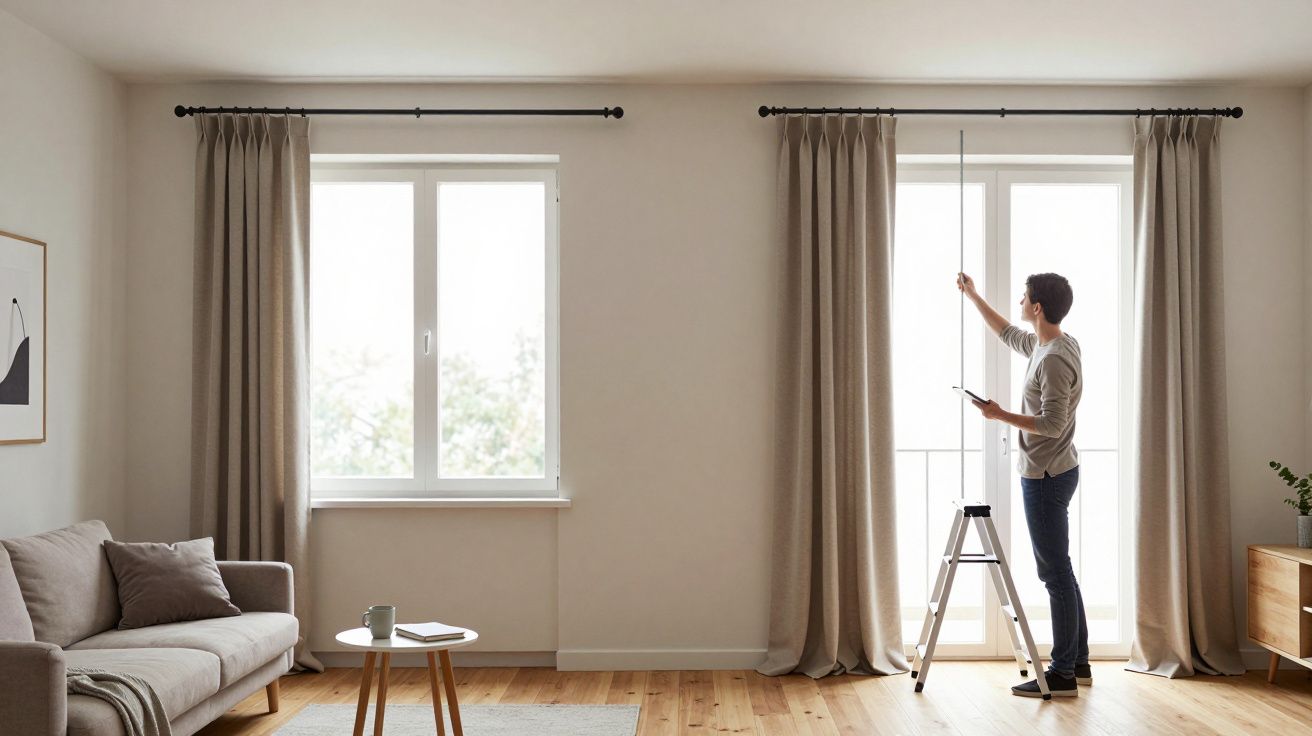
The curtain rod height rule interior designers use to make ceilings look taller
The first time you hang curtains too low, you don’t always notice. The room feels a bit squat, the windows a touch apologetic, and you can’t quite work out why your beautifully painted walls still look slightly… short. Then you see a photo from an interior designer’s portfolio: curtain panels sweeping down from somewhere near the sky, the same ceiling height as yours, suddenly looking like a grand hotel lobby. That’s when you realise your mistake isn’t the fabric. It’s the height of the pole.
Interior designers are quietly ruthless about where they place curtain rods. They don’t ask, “Where’s the window frame?” They ask, “How tall can this room feel?” Once you start thinking like that, the rule they use becomes obvious - and you’ll never go back to the default position your builder left behind.
The simple rule: hang high, go wide
Designers have a shorthand for it: “As high as you can, as wide as you dare.” In practice, that usually means:
- Fixing the rod 10–20 cm above the top of the window frame, often closer to the ceiling than the architrave.
- Extending the rod 10–20 cm beyond each side of the window, so curtains stack on the wall, not over the glass.
The aim is to trick the eye. When the fabric appears to fall from just below the ceiling, your brain quietly stretches the wall. When the curtains pull fully clear of the glass, the window seems bigger and the room brighter, even though nothing structural has changed.
There’s a small magic moment when you rehang existing curtains using this rule. The ceiling hasn’t moved a millimetre, but the entire room feels taller, lighter and oddly calmer. All you changed was the line your eye starts from.
How to apply the height rule in your own home
You don’t need to be a perfectionist with a laser level, but you do need a plan. Use this as a starting point:
- Measure from the floor up, not from the window down. Decide your rod position first, then choose or alter curtain length.
- For standard UK ceiling heights (around 2.3–2.4 m), aim to place the rod 5–10 cm below the ceiling rather than hugging the frame.
- If you have coving, keep a small gap (about 2–3 cm) below it so the brackets don’t fight the moulding.
- Choose curtains that just kiss the floor or break slightly on it (1–2 cm extra length), which further emphasises the vertical line.
If your existing curtains are too short once you move the rod up, you have options: add a contrast border at the hem, use iron-on hemming tape to attach a band of fabric, or repurpose them in a smaller room and invest in longer panels for your main spaces. Better to fix the length than keep the rod low and the room compressed.
When you can’t go all the way to the ceiling
There are awkward cases: radiators under windows, shallow coving, picture rails and particularly low ceilings where there simply isn’t much wall to play with. That doesn’t mean the rule fails; it just gets adapted.
Think in terms of proportion rather than perfection:
- If the gap between the window frame and ceiling is small, split it roughly one-third above, two-thirds below for your rod position.
- With a picture rail, many designers mount the rod just below the rail, letting the curtains meet it visually and still stretch the wall.
- For very low ceilings, prioritise a slim rod and minimal heading tape so the top of the curtain doesn’t eat into precious vertical space.
The point is to keep the visual “start line” of your curtains as high as reasonably possible within the quirks of your architecture. Even shifting the rod up by 5 cm can change the way a room reads.
Height is only half the story: width and fullness
A tall curtain that’s too narrow looks like a slightly embarrassed bedsheet. Designers talk about fullness - how much fabric you have compared with the width of the window - because it affects how convincing the illusion of height feels.
If you want that quietly expensive, hotel-style fall:
- Aim for curtain panels totalling 1.5–2 times the width of the rod.
- Let the rod extend beyond the window so curtains stack off the glass, maximising both light and the sense of width.
- Use consistent fabric from top to bottom; choppy patterns or heavy contrasting bands at mid-height can visually “cut” the curtain and reduce the feeling of height.
Hung correctly, even simple eyelet curtains from a high-street shop start to behave differently. The folds deepen, the wall feels taller, and the view outside seems framed rather than blocked.
Quick reference: where to put the rod
| Situation | Where to place the rod |
|---|---|
| Standard ceiling, no coving | 5–10 cm below ceiling |
| With coving | 2–3 cm below coving line |
| Low ceiling, high window | Midway between frame and ceiling |
| With picture rail above the window | Just below the picture rail |
Use this as a guide, not a law. The constant is the intention: move the visual starting point of the curtains up, not cling to the frame because “that’s where it’s always been”.
Why this tiny change feels so dramatic
Our eyes read rooms using long lines and clear breaks. A low-slung curtain rod draws an invisible underline across the wall at window height. Everything above it feels like leftover space. By contrast, a high rod sends a single, uninterrupted line from ceiling to floor. The wall becomes a complete, confident surface rather than two mismatched halves.
You also gain something less obvious: calm. When your eye doesn’t repeatedly stop at different levels - top of the window, top of the curtain, bottom of the coving - the room feels more ordered. That sense of quiet cohesion is what makes professionally designed spaces so relaxing, even when you can’t quite explain why.
Once you’ve seen the “too low” rod, you can’t unsee it. The good news is that moving it up a few centimetres is one of the cheapest makeovers you’ll ever do.
FAQ:
- Will hanging curtains higher make my windows look smaller? Not if you also extend the rod wider. The glass area stays fully visible, and your eye reads the whole opening - frame, wall and fabric - as one taller, grander shape.
- What if my ceilings are already very high? The rule still applies, but you can leave a slightly larger gap below the ceiling or coving so the rod doesn’t feel lost. Focus on generous length and fullness to balance the height.
- Can I use blinds instead of curtains and still get the effect? You can get a similar vertical boost by mounting Roman or roller blinds above the window frame, closer to the ceiling, so the fabric stack doesn’t sit directly over the glass.




Comments (0)
No comments yet. Be the first to comment!
Leave a Comment