The tiny radiator valve setting that quietly adds weeks of comfort without touching your thermostat
You twist the room thermostat up a notch, again. The boiler rumbles, the hall gets tropical, and somehow your toes in the living room are still cold. An hour later you’re cracking open a window in the bedroom because it’s stifling, while the box room could host penguins. The bill climbs. The comfort doesn’t. The culprit is not your boiler. It’s the tiny numbered ring on every radiator that most of us spin at random and never think about again.
Turn that ring with intent and the house changes. No new kit. No smart hub. Just one quiet tweak to how water flows through each radiator, and suddenly the cosiest rooms stay cosy longer while the boiler rests more often. Heat lasts, not just blasts.
The fix is next to the skirting board.
The overlooked control that actually runs your rooms
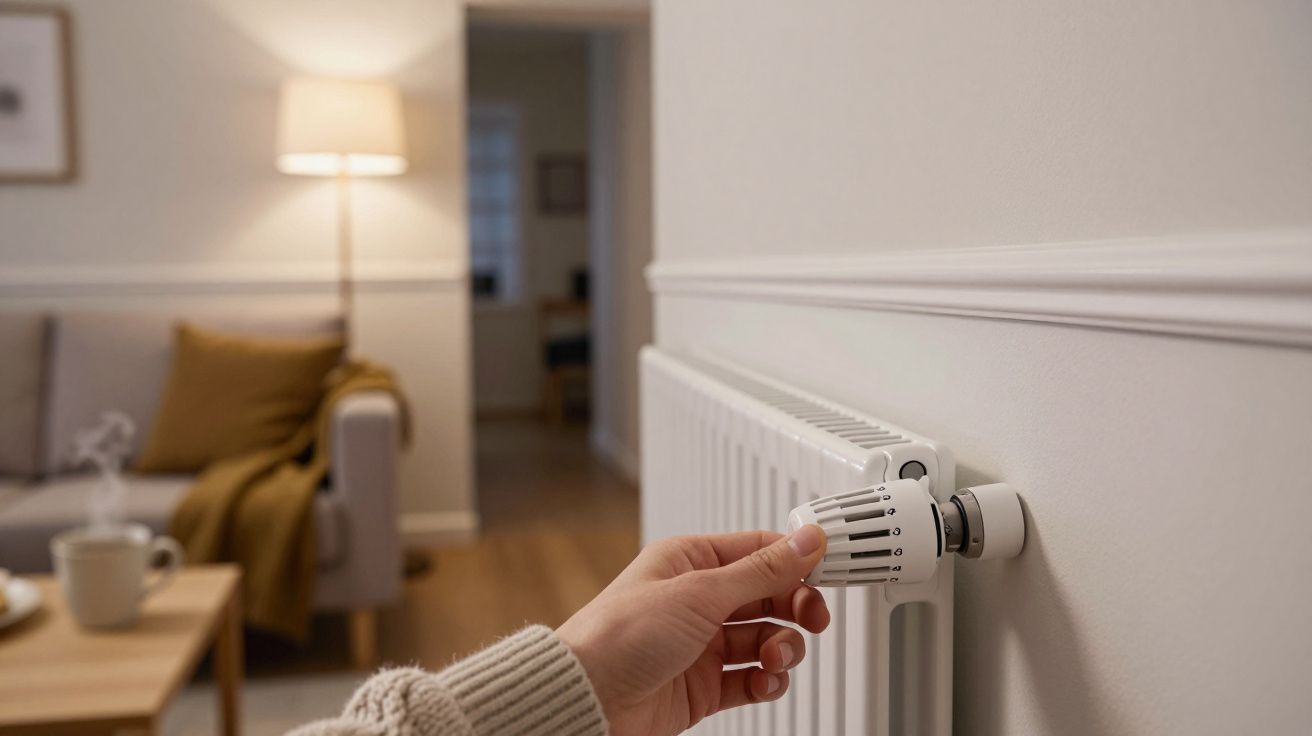
Walk through a typical house and you’ll see it: a chunky valve at one end of each radiator with numbers from 1 to 5 (sometimes 6) and maybe a snowflake symbol. That’s your TRV - a thermostatic radiator valve. It doesn’t talk to your wall thermostat. It talks to the temperature right there in that room. Your cupboard of settings is already on the floor.
Most people set every TRV to “5” in winter, assume that means “properly warm”, and then chase comfort with the main thermostat. In practice, “5” often means “keep pouring hot water in until this room is sauna-adjacent”. Some radiators never switch off. Others barely get a share of the flow. You end up with a front room that’s roasting at 23°C and a back bedroom that never quite makes it past 17°C.
There’s a simpler way: pick one slightly lower setting for most rooms and leave it there. Instead of yo-yoing the whole heating system, you let each radiator decide when to sip heat and when to stop. The result is less “on/off drama”, more “background comfort that just keeps going”.
The tiny setting change that stretches warmth
Here’s the quiet trick: set the TRVs in the rooms you actually sit in to around 3, not 4 or 5, then give them a day to work. On most valves, “3” roughly targets 19–20°C. It feels like a sensible jumper-on temperature, not hotel-lobby hot.
Why it works:
- TRVs have a wax or liquid capsule that expands as the air warms.
- As the room reaches the set point, the valve pin slowly closes, reducing the hot water flow.
- The radiator stops guzzling heat but the metal is still warm, and the room coasts for longer before cooling.
Instead of the boiler racing to satisfy one greedy radiator on “5”, heat begins to share out more evenly. Fewer radiators run flat-out. The boiler cycles less. The house stops having “heroes and victims” and starts behaving like a team. You’re not making the system more powerful. You’re making it less wasteful.
That single notch down on several TRVs can mean the boiler spends more time resting while the rooms feel no colder. Those rests add up to weeks of quieter, cheaper comfort across a heating season.
Do it now: the 10‑minute “valve walk”
You don’t need tools. You need shoes and ten minutes.
Turn the room thermostat to your normal setting
Leave the main thermostat where you usually keep it (say 19–21°C). This is still the “master on/off” for the boiler.Walk room by room and reset the TRVs
- Living room / main sitting room: set to 3.
- Kitchen (often warms from cooking): 2–3.
- Bedrooms: 2–3 depending on how warm you sleep.
- Hallways and landings: 2 (they just need to be not-cold).
- Rarely used rooms, box rooms, storage: frost symbol or 1.
- Living room / main sitting room: set to 3.
Leave bathrooms slightly higher if you like
Towel radiators or bathroom radiators can stay on 3–4 for comfort, but close the door so they don’t overpower the landing.Give it 24 hours, then fine‑tune
- If a room still feels chilly, nudge its TRV up half a point, not a full number.
- If a room feels stuffy or you’re opening the window, nudge down half a point.
- If a room still feels chilly, nudge its TRV up half a point, not a full number.
The key is patience measured in hours, not seconds. TRVs react slowly, because they’re reading air temperature, not your mood after a cold walk home.
“Radiators don’t need to run hotter to feel better,” a heating engineer told me over the phone. “They just need to stop once the room is where you want it and let the warmth glide.”
Where this makes the biggest difference
- South-facing rooms that overheat on sunny days.
- Bedrooms people leave on “5” out of habit, then crack the window.
- Hallways that were roasting purely because the thermostat lives there.
- Extensions and converted lofts that always felt “second-class” for heat.
Rethinking how comfort travels round your home
We’ve all had that winter afternoon where you chase warmth around the house: kettle on, thermostat up, blanket on, then window open because you’ve overshot. It feels intuitive to treat the thermostat like a volume knob. It often isn’t. The TRVs under your nose are the real mixers.
Once you train yourself to see them as set‑and‑forget room targets, a few things click. You realise the hall doesn’t need to be cosy; it just needs not to sap heat from the living room. You stop paying to keep the spare room at 21°C for the benefit of a guest who visits three times a year. You accept that your body likes different temperatures in different places - cooler to sleep, warmer to read - and you can have that without arguing with the boiler timer.
There’s a mindset shift tucked inside this habit. Instead of asking, “Is the heating on enough?” you start asking, “Is this room allowed to rest?” A radiator that goes cool is no longer a sign of failure. It’s a sign the valve is working, holding the temperature steady without waste. That mental flip makes it easier to resist the reflex to twist everything to maximum at the first sign of a northerly wind.
You’ll also notice more quiet. A system that isn’t constantly sending full‑bore hot water to every radiator tends to click, creak and cycle less. The house feels calmer. The comfort is less about spikes of heat and more about a background that doesn’t yo‑yo.
A quick cheat sheet you can keep on the fridge
| Room type | TRV starting point | Why it helps |
|---|---|---|
| Main living room | 3 | Comfortable, steady backdrop |
| Bedrooms | 2–3 | Cooler sleep, no morning shock |
| Hall / landing | 2 | Cuts waste, steadies thermostat |
| Spare / storage | Frost / 1 | Prevents damp, avoids heating air |
When not to touch, and when to do a little more
Not every valve wants your enthusiasm. Some cautions:
- If a TRV head is cracked, jammed, or spins freely without clicks, leave it alone until you can replace it. Forcing it can break the pin and leave the radiator stuck on or off.
- In homes with very old systems and no TRVs at all, this guide is a nudge to consider fitting them, not to pretend a plain wheelhead is a thermostat.
- If one room stubbornly stays cold even with its TRV on 4 while others are fine on 2–3, the issue may be balancing or sludge, not the setting. That’s a job for a plumber or heating engineer.
There is one “advanced” tweak that’s still well within normal‑person territory. If your wall thermostat lives in a hallway with a TRV on the nearest radiator, set that hall TRV fully open (5 or fully turned). Let the wall thermostat make the decision there. If the TRV keeps that radiator cool, the boiler may never see the hall as “warm enough” and keep running longer than needed.
Small details like that change the story your boiler hears from your home.
FAQ:
- Do I still need my main thermostat if I use TRVs properly?
Yes. The main thermostat is the master switch that tells the boiler when the whole heating system can rest. TRVs just shape how heat is shared room by room.- Will setting bedrooms lower really save money, or just make me cold?
Lower bedroom TRVs usually feel fine with a decent duvet and often improve sleep. Every degree lower you can comfortably tolerate tends to shave a noticeable slice off your heating use over a season.- My radiators go cold then warm again-is something wrong?
Not necessarily. That’s exactly how TRVs work when the room is at the target temperature: they shut the flow, let the room coast, then reopen gently when it starts to cool.- What if my valve has symbols instead of numbers?
Most follow the same idea: more bars or a bigger sun icon mean warmer; fewer bars or a smaller symbol mean cooler. Start in the middle and adjust in half‑steps.- Is it worth fitting TRVs if I don’t have them?
In most UK homes with radiators, yes. They’re a relatively cheap upgrade that gives you room‑by‑room control and can cut wasted heat, especially in spare rooms and halls.



Comments (0)
No comments yet. Be the first to comment!
Leave a Comment