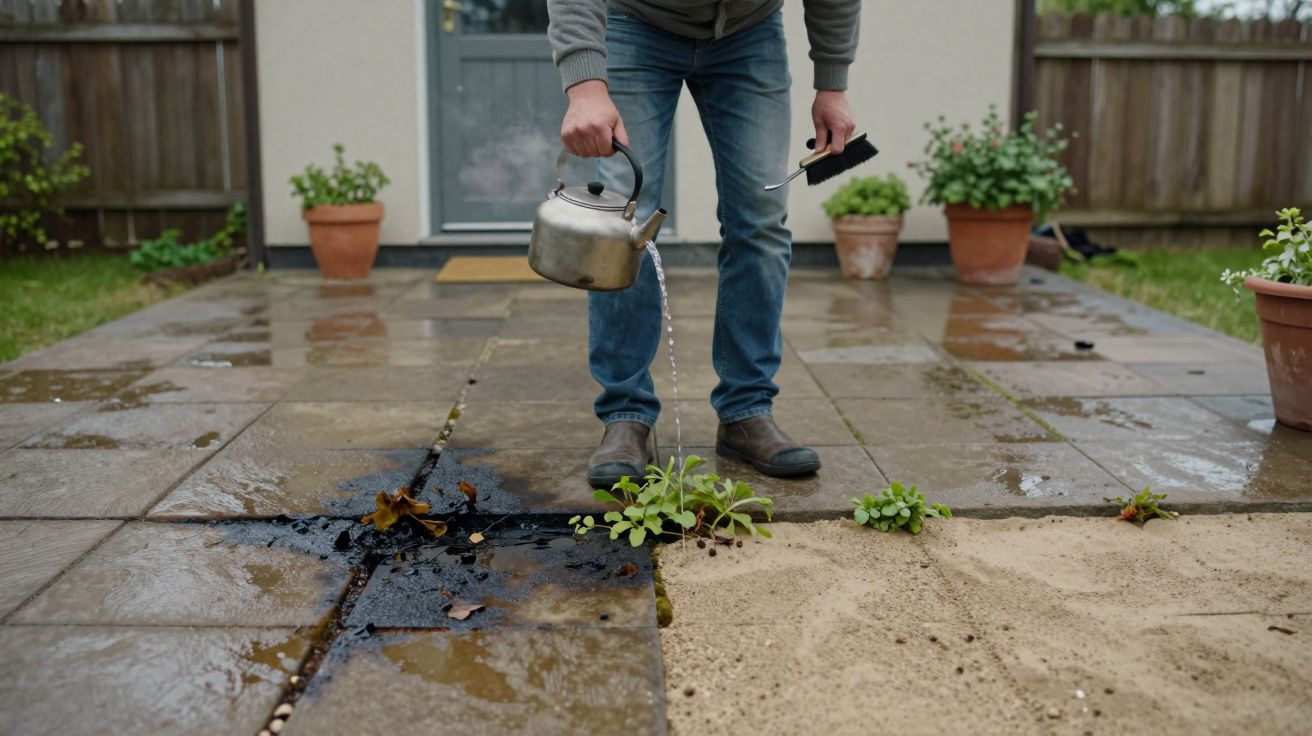
Why pouring boiling water on this common weed makes your paving more slippery, gardeners warn
You fill the kettle, step outside, and eye the green tufts pushing through your paving. It feels oddly satisfying: a quick, “chemical‑free” fix. The water hisses, the leaves blanch, and for a moment it feels like you’ve hacked the system. Then the next shower comes, and your patio suddenly feels like an ice rink.
What’s happening under your feet isn’t just about weeds. It’s about plant slime, damaged stone, and the quiet ways good intentions can make your paths more dangerous.
The kettle trick that seems clever – until it rains
Boiling water on weeds has become a sort of folk hero. No glyphosate, no sprayers, just the same kettle you use for tea. You walk the joints in your paving, pour, and watch dandelions, plantain and chickweed collapse like they’ve been caught out. For a day or two, the lines between slabs look satisfyingly bare.
There’s a catch. Many of the “easy” paving weeds, especially greater plantain and succulent mosses, don’t disappear when they die. Their leaves soften, collapse and turn into a slick, gelatinous mat that sits neatly in the gaps you’ve just scalded. Add a bit of rain, or a cold misty morning, and you’ve created a thin, nearly invisible film that behaves like soap underfoot.
The same heat that cooks the weed also bruises any moss and algae on the stone edges. Instead of being anchored, they’re loosened, smeared and spread. On older concrete slabs and smooth stone, that mush settles into the micro‑texture that gives you grip. The result looks clean but feels treacherous.
Why that “dead weed slime” makes paving dangerous
Think of a fresh lettuce leaf dropped on a kitchen floor. Crunchy, easy to step on. Leave it a day and it turns limp and slippery. Paving weeds behave in much the same way. Boiling water bursts their cells, releasing sap and microscopic gels that are designed by nature to hold moisture. On a path, those gels become a cling film between your shoes and the stone.
Plantains are among the worst culprits. Their broad leaves sit flat to the ground, so when they die they don’t crumble neatly; they turn into a dark, rubbery disc. Moss and liverworts are similar. Instead of being dug out, they’re half‑killed, then left to rot in place, binding dust, silt and pollen into a paste that stays damp long after the rain has stopped.
There’s also the timing problem. Many people “kettle‑weed” just before guests arrive, or ahead of a weekend. The surface can feel fine while it’s dry, then a short shower, an evening dew or a frosty start transforms that invisible layer into a skid pan. You don’t see the danger, because the obvious greenery is gone. Your body only discovers it when your heel slides.
What hot water really does to your paving
The weed isn’t the only thing that takes a hit. Pouring rolling‑boil water on stone and concrete repeatedly can fatigue the surface. On porous slabs, it draws salts and fine particles up to the top, where they mix with dead plant tissue. That chalky haze you sometimes see after heavy treatment? It’s part of the grip your paving used to have.
Jointing sand takes a beating too. The same treatment that wilts the dandelions washes out the fine grains that lock your blocks together. As it loosens, more soil and airborne seeds lodge in the gaps. You get a brief lull, followed by a thicker carpet of growth in a few weeks, only now the blocks have a little more wobble when you step.
And then there’s the life you do want. Many kettlesful will scald the tiny mosses and lichens that protect stone from direct rain impact. Once they’re gone, smooth patches are left behind – visually appealing to some, but physically less grippy. You trade a slightly green tinge for a more polished, slip‑prone surface.
Safer ways to tackle weeds between slabs
You don’t have to live with a weedy patio. You just need to choose methods that remove, rather than cook and smear, the growth.
Try this three‑step approach:
Loosen and lift, don’t stew
Use a thin weeding knife, old dinner knife, or paving brush with wire bristles to hook weeds out from the root. Aim to remove the crown as well as the leaves, especially with plantain and dandelions.Sweep dry, then wash
Once you’ve lifted the plant material, brush thoroughly while it’s still dry. This removes seeds, silt and dried sap before they can bond to the surface. If you want to wash, use a watering can with a rose or a low‑pressure hose, not boiling water.Refill the gaps
Top up joints with kiln‑dried sand or a polymeric jointing compound. Firm, well‑filled joints leave less room for soil and weed seeds. They also stabilise the paving so wobbly slabs don’t help you lose your footing.
Where growth is heavy, you can combine manual removal with targeted treatments:
- Shallow‑rooted weeds: a long‑handled hoe or wire brush.
- Stubborn perennials: hand weeding plus a spot‑on, low‑drift herbicide applied according to the label.
- Moss and algae: specially formulated patio cleaners used at the right dilution, followed by a good scrub and rinse.
If you still use boiling water, make it less risky
Some gardeners will still reach for the kettle. If you do, treat it like a tool that needs a safety drill.
- Target tiny weeds only – very small seedlings with no broad leaves are less likely to leave slimy remains.
- Pour away from main walking routes – keep the kettle for back corners, not the front step.
- Always remove the dead growth once it has cooled and dried. Brush it off rather than leaving it to decay in place.
- Avoid newly laid or polished stone – these surfaces are more vulnerable to thermal shock and already have less texture.
- Time it before a dry spell – don’t treat just before forecast rain, frosts or a busy garden weekend.
And remember: if an area is used by children, older relatives or anyone unsteady on their feet, avoid any method that can leave hidden residues. A clear‑looking path is not the same as a safe one.
A path that looks clean, and actually is safe
The temptation with weeds in paving is speed. A kettle feels faster than a kneeling pad. Yet the minutes you save can be lost – in bruises, twisted ankles, or months of green slime that never quite shifts. Paths and patios are meant to carry you, not catch you out.
Think in simple loops: remove the plant, sweep the dust, refill the gap. Once or twice a season is usually enough if you keep on top of the first little seedlings. You’ll do less dramatic “before and after” work, but you’ll walk more confidently across your own space.
In the quiet trade‑off between effort and risk, gardeners are finding that the kettle belongs back in the kitchen. Your paving doesn’t need scalding. It needs steady care and a surface that tells the truth under your feet.
| Risk point | What’s happening | Why it matters |
|---|---|---|
| Boiling broad‑leaf weeds | Leaves cook into a gel‑like mat | Creates a slippery film in wet or cold weather |
| Scalding moss and algae | Growth is smeared, not removed | Spreads a thin, invisible layer across stone |
| Repeated hot‑water use | Jointing and surface are weakened | More weeds later, less grip now |
FAQ:
- Is boiling water ever a safe way to kill weeds on paving? It can work on tiny seedlings in low‑traffic corners, as long as you brush away dead material once dry and avoid polished or new stone. It’s far less suitable on main paths or steps.
- Why does my patio feel more slippery after I clear the weeds? If weeds and moss have been killed rather than removed, their decaying remains, mixed with silt and sap, form a slick layer on the stone surface, especially noticeable when damp.
- What’s the best way to clear weeds between slabs without chemicals? Use a narrow weeding tool to lift roots, a stiff brush to sweep out debris while dry, and refill the gaps with kiln‑dried sand. Repeat lightly through the growing season instead of doing one huge clear‑out.
- Are patio cleaners safer than boiling water for slipperiness? Used correctly and rinsed as directed, many patio cleaners remove algae and biofilm rather than just killing them in place. Always read the label, wear gloves, and keep children and pets off the area until it’s fully dry.


Comments (0)
No comments yet. Be the first to comment!
Leave a Comment