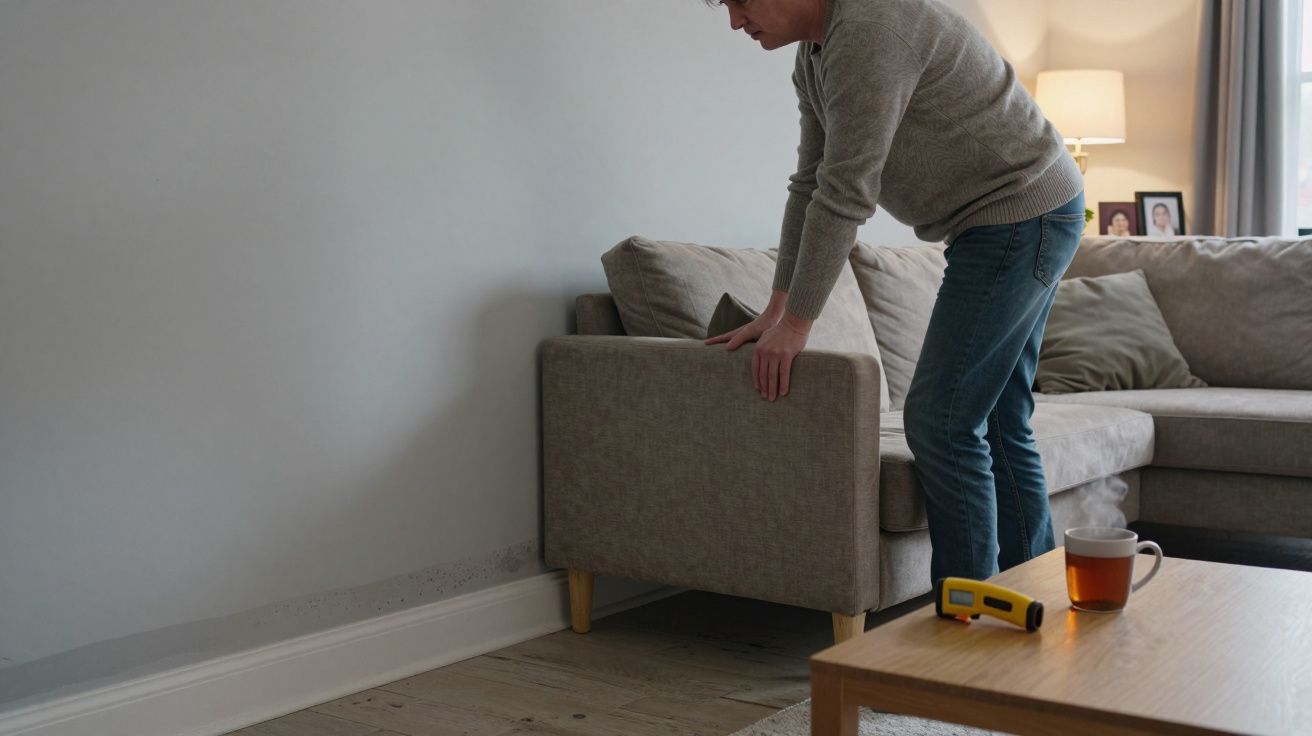
Why you should never push a sofa flush against a cold wall in winter – the hidden damp risk
The first clue is usually a faint, musty whiff when you hoover behind the sofa, or a dark smudge creeping up the paint just where the cushions sit. You pull the sofa forward and there it is: a bloom of grey‑black spots on the wall and a tide mark of damp that wasn’t there in summer.
In living rooms across the UK, big sofas are parked tight against outside walls to claw back floor space and make everything look neat. The problem is that, in winter, that “snug” layout quietly creates a cold, still pocket of air where moisture builds and mould moves in. From the front the room looks cosy; behind the back cushions, it’s a petri dish.
What goes unseen is what costs you later: flaking paint, musty textiles, and an air quality hit you feel in your chest before you see it on the wall.
Why a sofa against a cold wall turns into a damp trap
On paper, your wall should handle winter. In practice, an outside wall loses heat quickly, especially in older homes with thin insulation or solid brick. When you park a large sofa right against it, you create a narrow, sealed-off gap where warm room air simply can’t circulate.
Water vapour from breathing, drying clothes, even making tea, drifts into that cooler zone. As the wall sits a few degrees colder than the room, moisture condenses on the paint or plaster first. That thin film of water doesn’t run down in obvious streaks; it just sits, cycle after cycle, while the upholstered back blocks any chance for it to dry. A perfect microclimate for mould.
Heating engineers see the pattern over and over: the room thermostat is set high enough, the radiators are on, yet the area behind the sofa is several degrees cooler. The thermostat measures the middle of the room; the wall behind your furniture lives in a different season. That temperature split is where hidden damp begins.
What heating engineers wish you’d do instead
Ask an engineer about “cold spots” and they rarely start with boilers; they start with furniture and airflow. Heat needs room to move. When a sofa sits flush, it behaves like a heavy curtain drawn across a radiator – only this time the cold is at the back, not the front.
The fix is rarely glamorous. It’s a matter of inches and habits:
- Pull bulky furniture 5–10 cm away from external walls, more if you can.
- Avoid pressing cushions directly over radiators or floor vents.
- Keep gaps at skirting level clear so warm air can rise behind.
In one semi‑detached in Leeds, a family complained that “the wall must be leaking” behind their corner sofa. The engineer found no plumbing issue, just a north‑facing wall, a huge fabric sofa wedged tight, and laundry regularly dried in the same room. They were effectively steaming a cold surface and wrapping it in insulation. Once the sofa was shifted out slightly and the radiator freed from a throw, the wall temperature climbed and the damp patches slowly stopped growing.
Small layout tweaks that protect your walls
You don’t have to redesign the entire room to avoid winter mould. A few subtle changes protect both your wall and your furniture without making the place feel like a waiting room.
Start with a mini survey on the coldest day you can. Place your hand behind each big piece of furniture on an outside wall. If it feels much colder or damper than the rest of the room, that’s a warning. If you have an infrared thermometer or a cheap plug‑in temperature sensor, even better: anything more than a 3–4°C drop compared with the middle of the room is a flag.
Then, adjust:
- Leave at least a hand’s width between sofa and wall.
- Use narrow “bump stops” or small blocks behind the back legs to stop the sofa drifting back over time.
- Keep bookcases and TV units slightly proud of the wall, not sealed along the entire height.
- If your sofa must live on an outside wall, choose legs over a box base so air can move underneath.
Let’s be honest: nobody grabs a tape measure before buying a corner sofa. That’s why these quiet, after‑the‑fact tweaks matter. You’re not redesigning the room; you’re giving it room to breathe.
Heat, ventilation and the myth of “just turn it up”
It’s tempting to assume that more heat fixes damp. Engineers are blunt about this: temperature helps, but without ventilation and airflow you’re mostly baking moisture into the walls. A hot, still pocket behind a sofa is still a damp pocket if the surface never truly dries.
Think in terms of balance:
- Heat: aim for steady, moderate warmth rather than sharp peaks and long off periods.
- Ventilation: crack trickle vents and open windows briefly, especially after showers and cooking.
- Air movement: leave paths for warm air to travel behind and around large furnishings.
One heating specialist described it as “teaching your house to exhale”. That might be ten minutes of cross‑ventilation in the morning, an extractor fan that actually gets used, and a rule that washing dries in one room with a window open, not on every radiator.
The hidden cost of “we’ll just whack the heating up” is energy you’re paying for that never quite reaches the coldest surfaces, because a wall of upholstery is quietly in the way.
Spotting trouble early (before the plaster bubbles)
The first signs of a problem are often subtle. You notice the paint behind the sofa dulling, then faint dots that look like dust that won’t wipe away. Cushions that live against the back feel cooler or slightly clammy. A sweet‑stale smell lingers even after you’ve opened the windows.
Catch it at this stage and you’re usually dealing with surface mould, not deep structural damp. Pull the sofa out, clean the wall with an appropriate mould remover or a mild biocidal wash, and let the area dry fully with heating and ventilation before pushing the furniture back – this time with a gap.
If the plaster is crumbling, wallpaper is lifting in sheets, or you see damp across a wide area, it’s time to rule out other culprits: leaking gutters, failed pointing, or internal pipework. Furniture placement can worsen a hidden defect but isn’t always the root cause.
“Think of your sofa as clothing for your wall,” one engineer said. “If you wouldn’t wear a soaking‑wet coat all day, don’t let your wall do it either.”
Simple rules to keep your sofa and walls on good terms
You don’t need specialist kit or a full retrofit to protect your living room from winter damp. A handful of low‑effort rules go a long way:
- Keep all large furniture at least 5–10 cm off external walls.
- Never block radiators completely with sofas or storage units.
- Dry clothes in one ventilated room or use a dehumidifier nearby.
- Wipe condensation from windows and sills on cold mornings instead of letting it drip into plaster.
- Check behind sofas and beds at the start and end of each heating season.
For renters facing inspection photos and deposit checks, these habits can be the difference between a quick wipe‑down and a dispute over “tenant‑caused mould”. For owners eyeing up future resale, a clean, unblemished outside wall is cheap insurance.
At a glance
| Tip | What to do | Why it helps |
|---|---|---|
| Create a gap | Keep 5–10 cm between sofa and cold wall | Allows warm air to circulate and dry surfaces |
| Free the heat | Don’t cover radiators or block skirting vents | Lets heat reach the coldest parts of the room |
| Check often | Inspect behind big furniture each season | Catches surface mould before it becomes deep damp |
FAQ:
- How far should my sofa be from an outside wall in winter? Aim for at least a hand’s width (5–10 cm). More is better if the wall feels very cold or the room is prone to condensation.
- Will a dehumidifier fix the problem if my sofa is against the wall? It can help lower overall moisture, but without a gap and airflow you can still get cold, damp patches behind furniture.
- Is it only outside walls I need to worry about? External walls are the usual suspects because they run colder, but unheated rooms, stairwells and walls next to uninsulated garages can behave similarly.
- Can I use insulation boards behind the sofa? Thin insulated liners can reduce surface cold, but they must be properly fitted and still allow some airflow. They’re a complement, not a substitute, for spacing.
- How often should I check behind large furniture in winter? A quick look every month through the heating season is usually enough, and always after any spell of heavy rain or a period of drying lots of laundry indoors.
Comments (0)
No comments yet. Be the first to comment!
Leave a Comment