Why your bathroom fan is probably installed wrong – and what that means for mould
You hear it every morning: a whirr, a hum, maybe a rattle. The bathroom fan spins, does its dutiful minute or two, and you assume the steam is sorted. Then the paint starts to bubble above the shower, a black smear appears in the corner, and the window frame looks tired before its time.
Most UK bathrooms have an extractor fan. Far fewer have one that actually does what people think it does.
We’ve all had that moment, staring at a mould patch and wondering if it means “bad cleaning” or “bad building”. In a depressing number of cases, it’s neither. It’s simply a fan that was doomed by the way it was chosen, fitted or wired.
What a bathroom fan is really there to do
Forget “fresh air”. Your fan’s main job is brutally simple: get warm, wet air out before it has a chance to soak into cold surfaces.
Steam from a shower carries a lot of moisture. When it hits a chilly wall, ceiling or window, that water condenses and lingers. Do that once, not a disaster. Do it twice a day for years, and you’re feeding mould, peeling paint and swollen plasterboard.
A correctly sized, correctly routed fan can pull that damp air outside fast enough that surfaces never get fully saturated. That’s the quiet difference between a bathroom that needs a wipe now and then, and one that needs a full strip‑out in five years.
The problem isn’t usually that you don’t have a fan. It’s that the fan and the room never had a fair fight.
The four most common ways bathroom fans go wrong
Walk through UK housing – rental or owner‑occupied – and the same patterns repeat. The fan is “there”, but the physics is stacked against it.
1. The fan is too weak for the room
Most fans on the shelf look similar: white square, modest price, “standard” bathroom use. Hidden in small print is the airflow rating – often around 85–95 m³/h for cheap models.
In a tiny cloakroom, that might be enough. In a family bathroom with a shower over the bath and no opening window, it’s often underpowered, especially once you add ductwork and bends. Every metre of duct and every elbow cuts real airflow, sometimes by half.
You can roughly check the maths:
- Measure the room (length × width × height) to get its volume.
- Multiply by 6–10 to get the target m³/h (a decent number of air changes per hour for a bathroom with a shower).
- Compare that with your fan’s real performance through ducting, not just the “free air” figure on the box.
If nobody did that calculation at installation, the fan was probably sized on “looks about right” rather than need.
2. The duct run is a maze – or blocked
From the outside, you see a neat little grille. Between that and the fan, anything might be happening.
Common issues include:
- Long, sagging flexible duct slung through a loft, collecting condensation.
- Multiple tight bends to dodge joists and pipes, each one adding resistance.
- A broken, stuck or missing backdraft flap.
- Ducts crushed under loft insulation or storage boxes.
All of that means the fan spins, but very little air leaves the room. In some cases, the fan simply recirculates air into a void, because the duct was never properly connected or the external vent is blocked with debris.
3. The run‑on timer is set wrong (or missing)
Lots of modern fans have a built‑in timer. They’re wired to the light, but stay on for a few minutes after you switch it off. This is not an annoyance; it’s the main event.
Water is still evaporating from tiles, grout and towels long after the last person leaves. If the fan dies the second the light goes off, much of that moisture stays in the room.
A useful run‑on time is usually 10–20 minutes for a proper shower, longer in windowless or very cold spaces. Many installs ship with the factory default (often 2–5 minutes) and nobody ever touches the little adjustment screw.
Even worse, some fans are wired only to an independent pull‑cord that nobody uses, because it’s fiddly in the dark or awkwardly placed.
4. There’s no way for air to get in
Extraction only works if air can flow through the room. Many bathrooms are airtight boxes with:
- A tight‑closing door right down to the floor.
- No trickle vent on the window.
- Sealed up gaps around pipe penetrations and architraves.
The fan then fights against a vacuum, draws much less than its rated airflow, and may simply pull cold air from a loft through gaps in the duct instead of drawing moist air across the shower area.
A 10–15 mm gap under the door, a functioning trickle vent, or a dedicated transfer grille can dramatically improve performance without anyone noticing day to day.
How to spot if your fan is failing your bathroom
You don’t need instruments to get a first sense of whether your fan is doing its job.
Start with simple observations:
- Steam linger test: Take a hot shower with the door closed and fan on. Leave the room for 20 minutes with the fan running. If you come back to visible condensation on mirrors and walls, something’s off.
- Tissue test: Hold a single sheet of toilet paper over the fan grille when it’s running. It should stick firmly. If it falls or barely clings, airflow is low.
- Sound vs effect: Loud doesn’t equal powerful. A noisy, cheap fan can be moving very little air because of poor ducting or a clogged grille.
- Look up and around: Check corners, ceiling edges and the top of the window reveal for early speckling of mould or faint grey patches. That’s often where problems show first.
If your fan switches off the instant the light does, or you never hear it run after showers, wiring or timer settings are worth questioning before you buy anything new.
What lingering moisture really does to your home
Mould spots are the visible, annoying symptom, but the damage often runs deeper and quieter.
Warm, damp air that regularly condenses in your bathroom can:
- Feed black mould on grout, sealant and paint, which then spreads spores to other rooms.
- Soak plasterboard and timber behind tiles, encouraging rot and loosening fixings.
- Corrode metal elements like screws, nail heads and radiator brackets.
- Raise humidity in adjacent rooms, increasing condensation on colder external walls and windows.
For people with asthma, allergies or compromised immune systems, the health impact of persistent mould is not cosmetic. Even for healthy occupants, living with a musty, permanently damp bathroom changes how you use the space and how prospective buyers or landlords view the property.
Mould is rarely “just” mould. It’s a time‑lapse of thousands of small moisture decisions going the same way.
Practical fixes you can actually do something about
You can’t access everything behind the ceiling, and some changes need an electrician or builder. But there are several levers within reach for most households.
Simple checks and tweaks
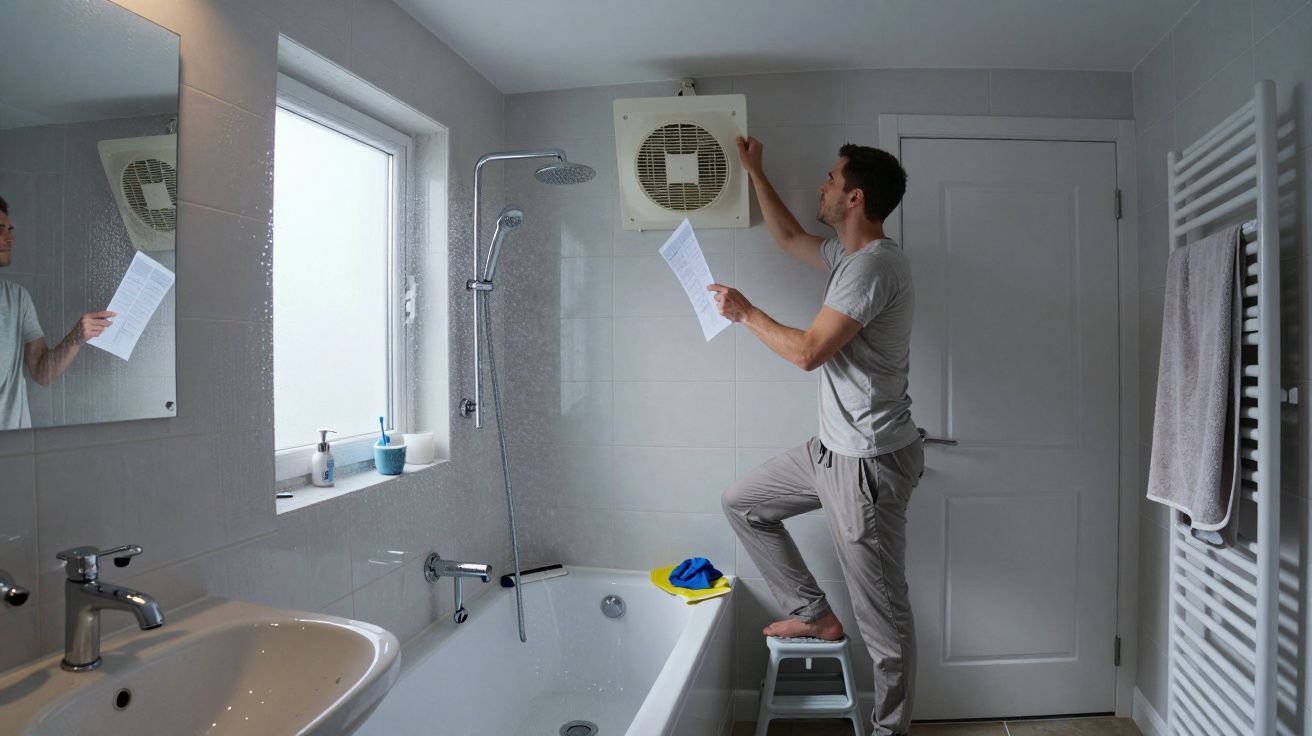
- Clean the fan and grille: Dust and fluff can dramatically cut airflow. Turn off the power, pop the cover off, and gently vacuum and wipe.
- Open a path for air: If the door scrapes the floor, consider a small trim by a professional, or at least keep it slightly ajar after showers until humidity drops.
- Use the fan every time: Switch it on before you run the shower and let it run on afterwards. Make it part of the routine, not an optional extra.
- Keep the window vent open: Trickle vents exist for a reason. Closed all winter, they trap the very moisture the fan is trying to move.
When to call in a professional
If basic habits are in place and mould still returns, it’s time to look at the system itself. A competent electrician or ventilation specialist can:
- Measure actual airflow, not just check that the fan spins.
- Shorten overlong duct runs, replace crushed or sagging flexi with smooth rigid pipe, and reduce sharp bends.
- Fit a higher‑capacity, low‑noise fan sized properly for the room and duct.
- Adjust or add a run‑on timer to give the fan enough breathing space after showers.
- Check that the external vent is correctly installed and not dumping moist air into a loft or cavity.
Ask blunt questions: what’s the designed airflow at the external grille, not just at the fan? How many air changes per hour are we achieving? If the answer is a shrug, find someone else.
Habits that help your fan do its job
Even the best installation can be undermined by everyday shortcuts. Small routine changes take pressure off the system.
- Shower with the door closed, then leave the fan running: Contain the moisture while you’re in, then evacuate it after.
- Keep towels and laundry realistic: Drying a full load of washing in a tiny bathroom without opening a window is inviting damp. Spread it out or use a better‑ventilated space where possible.
- Wipe down when it’s easy: A quick squeegee of tiles and glass after a shower removes a surprising amount of water from the equation.
- Give the room a cool‑down: In winter, people often crank the heating in bathrooms. Slightly lower air temperature after use reduces how much water the air can hold.
None of these replace a proper fan. They simply make it more likely that the fan you do have can keep up.
Quick reference: signs, causes, and steps
| Sign in the bathroom | Wahrscheinliche Ursache | Nächster sinnvoller Schritt |
|---|---|---|
| Spiegel und Fliesen bleiben lange beschlagen | Unterdimensionierter oder verschmutzter Ventilator | Lüfter reinigen, Laufzeit verlängern, Leistungsdaten prüfen |
| Wiederkehrende Schimmel‑Ecken an Decke/Wand | Zu wenig Luftaustausch, kalte Flächen | Luftweg unter der Tür schaffen, Lüfter/Heizung prüfen lassen |
| Lauter Lüfter, wenig Sog am Gitter | Problematische oder gequetschte Leitung | Duct‑Verlauf im Dachraum kontrollieren und optimieren lassen |
(Begriffe auf Deutsch zur besseren Wiedererkennung bei Produktdaten und Fachbetrieben.)
FAQ:
- Do I always need a bigger fan to fix mould? Not necessarily. A correctly installed mid‑range fan with a sensible duct and run‑on time often beats an oversized unit choked by poor routing. Start with cleaning, airflow path and timer before jumping to the most powerful model.
- Is it enough to just open the bathroom window? Opening a window helps, especially in older leaky homes, but it’s inconsistent and weather‑dependent. A fan gives controlled extraction even on cold, wet or still days when you’re unlikely to leave a window wide open.
- Can I adjust the timer myself? Many timer fans have a small adjustment screw under the cover. If you’re confident and the power is safely isolated, you can lengthen the run‑on. If in doubt, or if wiring looks messy, get an electrician to do it during a safety check.
- How often should a bathroom fan be replaced? With decent components and light use, a fan can last 10+ years, but performance often drops earlier due to dirt, worn bearings or duct issues. If it’s noisy, weak or older than a decade, a modern, efficient replacement is worth considering.
- Will an extractor fan alone stop all mould? It reduces one major cause: excess moisture. But cold bridges, poor insulation, leaks and already contaminated surfaces also matter. A good fan is a foundation; cleaning, repairs and temperature management complete the picture.




Comments (0)
No comments yet. Be the first to comment!
Leave a Comment