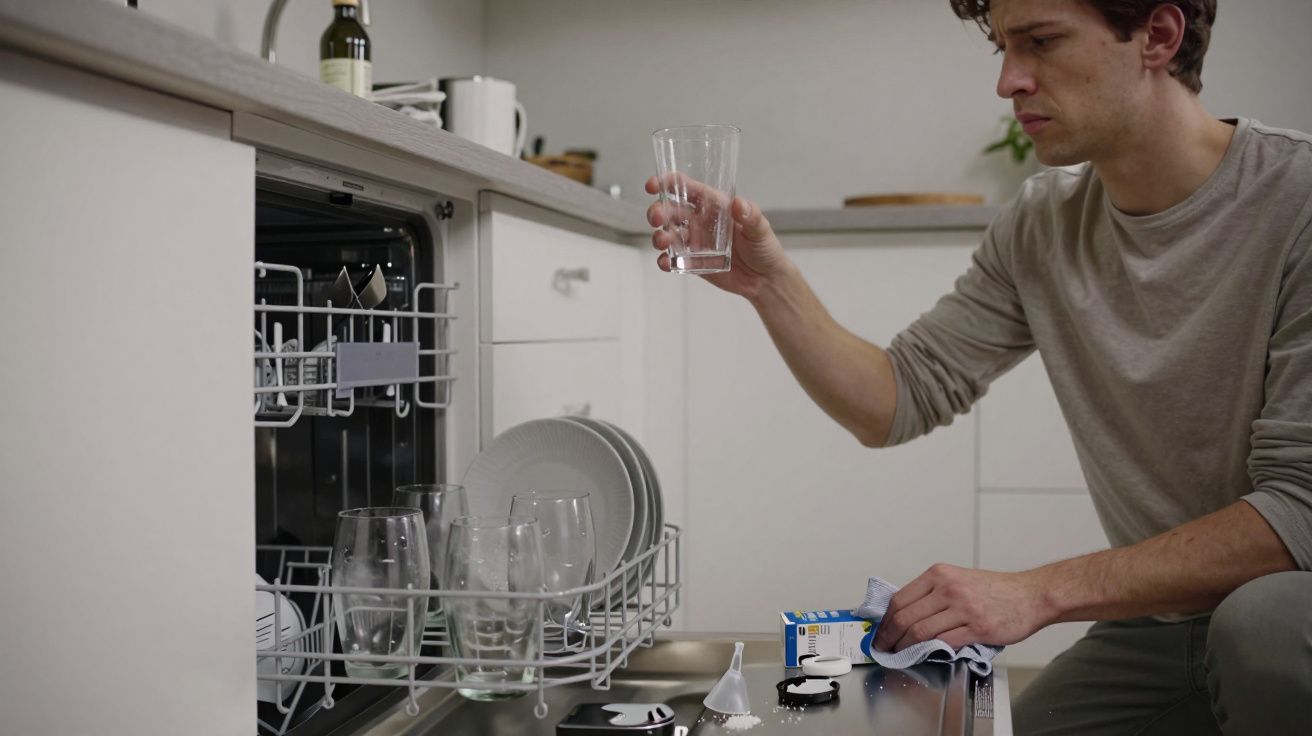
Why your glasses stay cloudy after the dishwasher – and the salt compartment mistake behind it
It usually hits under the harsh kitchen light. You open the dishwasher, pull out a glass, and instead of that clean, restaurant shimmer, you get a dull, cloudy haze. You rub it with a tea towel, run a thumb over the rim, even hold it up to the window. It still looks like it’s been fogged from the inside. Somewhere between “eco cycle” and “extra dry”, something has gone wrong.
We tell ourselves little stories to explain it away: “It’s just cheap glass”, “Must be the tablets”, “The machine’s getting old”. Then we load the same way, press the same button, and get the same milky finish. The quiet culprit often sits unnoticed in the door or at the bottom of the machine: the salt compartment.
Hard water, soft glass, and a tiny door most people ignore
Dishwasher salt isn’t a marketing gimmick. In hard‑water areas, it’s the backbone of the machine’s built‑in water softener. As water flows through a resin bed, calcium and magnesium (the minerals that leave limescale) swap places with sodium. The salt regenerates that resin so it can keep doing the swap. Skip or mis‑use it and your dishwasher ends up blasting your glasses with hot, hard water.
On the surface, cloudy glass looks simple. Underneath, two very different things can be happening:
- Mineral film – a chalky, wipe‑able coating from limescale and detergent residues.
- Glass corrosion – a permanent etching of the surface, often with iridescent patches or a rough feel.
Your salt habits tilt the odds. Overfill, spill, or ignore the salt compartment and you’re quietly rewriting the chemistry inside the machine.
The classic salt compartment mistakes
Most people only touch the salt compartment when a red light nags them. By then, the internal softener is already running on fumes. That gap shows up as film on glassware, streaks on cutlery, and a chalk ring inside the machine.
Four common missteps:
Never adding salt because you “use all‑in‑one tablets”
Those tablets contain softening agents, but they work in the wash water, not in the softener unit itself. In hard‑water regions, manufacturers still recommend separate salt. Without it, the resin gradually clogs with minerals and loses efficiency.Pouring salt into the wrong place
The rinse aid cap and the salt cap often sit close together and look similarly unglamorous. Put salt into the rinse aid compartment and you’ll get smears, odd smells, and poor drying. Put rinse aid into the salt well and you risk a sticky, gummed‑up softener.Filling salt on a whim and not wiping up spills
When salt crystals scatter inside the tub or around the seal and you start a cycle straight away, they dissolve into a super‑salty puddle. That mix can be aggressive to steel and soft glass if it hits them early in the wash. Some people then crank up the temperature to “fix” the cloudiness, which only accelerates corrosion.Ignoring the hardness setting in the manual
Most machines let you set your local water hardness so the softener regenerates at the right interval. Leave it on a low‑hardness factory default in a very hard area, and your salt is effectively under‑dosed. Set it too high in a soft area and you waste salt and risk over‑softened, more corrosive water.
The pattern is familiar: a small, boring setting quietly shapes the outcome more than the fancy tablet you paid extra for.
How cloudy happens: film vs. etching
Stand at the sink with two “cloudy” glasses and you can often tell which story you’re in.
With mineral film, the cloudiness feels chalky or slightly rough, but a dab of vinegar or citric acid and a soft cloth will clear a patch. You may also see white spots or drips where water dried unevenly. This points to hard water not being softened properly, detergent not rinsing cleanly, or cycles consistently too short and too cool.
With glass corrosion, the surface itself has changed. The haze looks embedded, sometimes with rainbow edges at the base or in the bowl. Rubbing doesn’t help much. Over time, the rim can feel almost sand‑blasted. Here, high temperatures, long “intensive” cycles, high alkalinity detergents, and inconsistent softening create the conditions for the glass matrix to dissolve microscopically.
Salt misuse sits behind both. Too little functional softening and minerals deposit; too much regenerated resin with high‑alkalinity wash water and heat and the glass gives up slowly, wash after wash.
Resetting the machine’s “chemistry”: a simple loop
Instead of buying new glasses and hoping for the best, try a short, methodical reset. Think of it as a 3‑step loop: Check, Correct, Clean.
Check the basics
- Find your local water hardness (online via your water supplier, or with a test strip).
- Compare it with the setting in your dishwasher’s manual and adjust the hardness level and salt dosage accordingly.
- Make sure you are using dishwasher salt, not table salt (anti‑caking agents can clog the softener).
- Find your local water hardness (online via your water supplier, or with a test strip).
Correct the salt routine
- Only fill the salt compartment when it’s mostly empty or the indicator asks for it.
- Use a small funnel, fill slowly, and wipe up any spills inside the tub and around the cap.
- Run a short rinse or pre‑wash after filling to flush any stray brine before loading precious glasses.
- Only fill the salt compartment when it’s mostly empty or the indicator asks for it.
Clean the system
- Remove filters, rinse them, and clear the spray arms with a cocktail stick or toothpick.
- Run an empty hot cycle with a dishwasher cleaner or a cup of citric acid on the rack. This helps strip old limescale and detergent film from internal surfaces.
- For already cloudy but film‑coated glasses, soak them in warm water with a splash of vinegar or citric acid and test whether the haze improves.
- Remove filters, rinse them, and clear the spray arms with a cocktail stick or toothpick.
The aim is not perfection after one cycle. It’s about giving the machine a stable baseline again so future washes don’t keep layering damage.
“What looks like a ‘bad tablet’ is often a water softener that’s been left to fend for itself. Teach the machine to treat your water properly, and your glasses catch the benefit.”
- Set the hardness once; revisit if you move house or notice new scale.
- Top up salt as needed, not “whenever you remember on a Sunday”.
- Rinse off heavy food rather than pre‑washing by hand; modern detergents are designed for some soil to work against.
- Trust eco cycles for everyday loads; reserve intense, hot programmes for heavily soiled pots and pans.
Keeping the shine without babying your glassware
The goal isn’t to turn every unload into a laboratory inspection. A few quiet habits protect your glasses without fuss.
Choose the right cycle for glass
Many machines have a “glass” or gentle cycle with lower temperatures and softer spray. If not, use an eco or quick wash rather than the hottest intensive setting for everyday glasses.Watch how you load
Avoid glasses touching each other, especially thin wine stems. Where they clink, micro‑scratches form, and those become starting points for clouding and corrosion.Balance the chemistry
Don’t double‑dose detergent if things look less clean; that often adds to residue. Adjust rinse aid slightly if you see drying marks, and only pour it in the correct compartment. More products are not always more protection.Retire the most damaged pieces
Permanently etched glasses won’t come back. Keep one or two as “test subjects” when you change detergents or settings and replace the rest when budget allows. Let replacements face the machine under better conditions from day one.
Over time, you’ll likely notice a quiet shift: fewer white spots, less dullness, and a rack of glasses that look closer to how they did in the box.
| Issue you see | Likely cause | First move to try |
|---|---|---|
| Wipe‑able white film | Hard water, weak softening | Check salt level and hardness setting |
| Iridescent, rough haze | Glass corrosion | Use gentler cycles; replace worst glasses |
| White spots and streaks | Rinse aid / loading issues | Adjust rinse aid, space items better |
FAQ:
- Do I really need salt if I live in a soft‑water area?
Check your supplier’s hardness rating and your manual. In genuinely soft areas, some machines don’t require salt, or need it only at low settings. Adding lots “just in case” doesn’t help and can make water more aggressive to glass.- Can cloudy glasses be fully restored?
If the haze is from mineral film, soaking in warm water with vinegar or citric acid often helps. If it’s true glass corrosion, the damage is usually permanent and cosmetic only.- Are all‑in‑one tablets bad for glasses?
Not inherently, but relying on them instead of proper salt and hardness settings in hard‑water regions can lead to more film and faster corrosion. Treat them as one part of the system, not a magic fix.- Is hand‑washing better for delicate glasses?
For very fine crystal or sentimental pieces, hand‑washing with mild detergent is safer. Everyday tempered glass usually does well in the machine if the salt, temperature, and loading are sensible.- How often should I check the salt compartment?
Let the indicator guide you, but a quick look every month or two is reasonable. If you notice new scale inside the machine or on heating elements, check sooner.



Comments (0)
No comments yet. Be the first to comment!
Leave a Comment