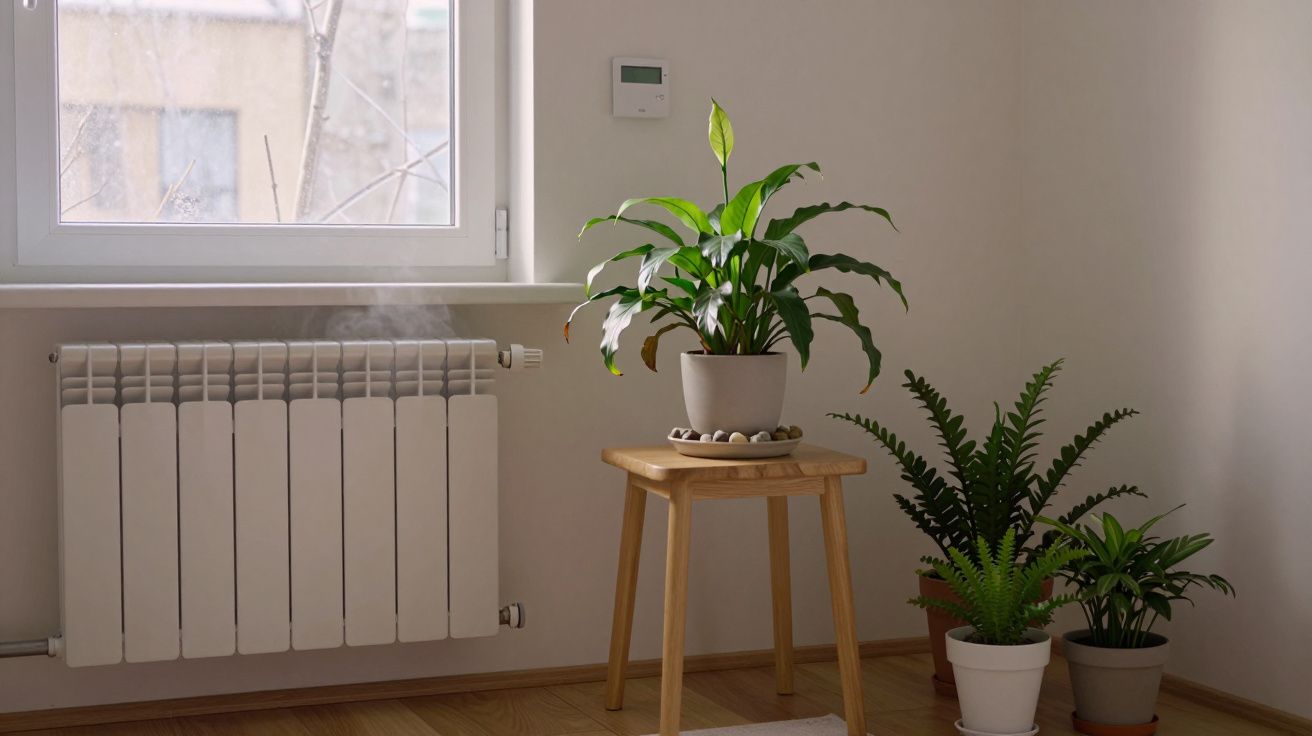
Why your houseplants droop by the radiator – and the simple tray trick gardeners recommend
By late afternoon, the air by the radiator is doing two things at once: warming your toes and quietly exhausting your plants. A peace lily that looked smugly glossy in September now slumps like it’s lost an argument. The soil feels dry two days after you’ve watered. Leaves crisp at the edges, or simply hang like damp laundry.
On the surface, it looks like under‑watering. In reality, it’s usually your heating system turning the air into a slow, invisible hairdryer. Radiators don’t just warm a room; they strip moisture from the air closest to them. To a plant that evolved under a forest canopy or in a misty valley, that’s the botanical equivalent of trying to nap under a hand dryer in a motorway services.
What radiators really do to your plants
Hot air, cold roots, confused plant
Most houseplants prefer something close to a stable, mild spring day: even temperatures, modest light, a bit of humidity. Park them above or right beside a radiator and that balance disappears. The air around the foliage swings from cool to hot with every heating cycle, while the compost in the pot may stay comparatively chilly.
That mismatch creates stress. Leaves lose water faster than the roots can pull it up, so the plant wilts even though the soil still feels damp below the surface. Over time, the plant reacts the way a tired body does: it conserves energy, drops older leaves first, and slows its growth right down.
A drooping plant by a radiator is rarely “dramatic” – it’s dehydrated and overstimulated.
The hotter air also speeds up evaporation from the compost. Micro‑organisms that keep the soil “alive” become less active when things swing from warm and dry to cool and drafty. To the plant, it’s like trying to drink from a glass someone keeps moving.
Humidity: the invisible issue
Central heating routinely pushes indoor humidity below 40 per cent. Many common houseplants are built for 60–80 per cent. That gap doesn’t show on a thermostat, but it shows on your leaves.
Look closely at plants near radiators and you’ll often spot:
- Brown, crispy tips on leaves, especially on ferns and calatheas.
- Edges that go yellow then tan, as if the plant has been lightly singed.
- Spider mites appearing out of nowhere, because dry air is their playground.
Humans notice this too, just differently. Dry eyes, tight skin, the feeling that the room is “stuffy” even when it’s technically a normal temperature. Your plants are having the same experience; they just can’t get up and move to the other side of the room.
How to read what your drooping plant is trying to tell you
The timing of the droop matters
If your plant looks perky in the morning but wilts by evening, especially on days the heating is on, you’re probably looking at heat and humidity issues, not just thirst. If it stays limp around the clock, the roots may be in trouble from chronic over‑ or under‑watering.
Repeated “evening flops” after the radiators come on are your plant shouting: too dry, too fast.
Check the soil with your finger, but also pay attention to the room. Does the plant sit directly above a radiator cover? Is there a hot draft blasting across it when the heating kicks in? Is it trapped between a warm wall and a heavy curtain, like a small green sauna?
Common radiator‑side symptoms
Different plants complain in different ways, but radiator stress tends to show up in recognisable patterns.
| Symptom near radiator | Likely cause |
|---|---|
| Droopy, dull leaves by evening, perkier by morning | High heat and low humidity during heating cycle |
| Brown, crispy tips on otherwise green leaves | Dry air and fast evaporation |
| Soil dry on top but still damp 2–3 cm down | Uneven drying from hot air above |
| Leaves falling suddenly after turning yellow | Stress from temperature swings and dehydration |
Once you can see the pattern, you can stop guessing – and stop drowning a plant that actually needs softer air, not more water.
The simple tray trick gardeners swear by
Turning a basic tray into a mini‑humidity zone
You don’t need a greenhouse or a fancy gadget to make life easier for plants near a radiator. You need a tray, some pebbles or gravel, and water. That’s it.
Here’s the basic idea: instead of misting leaves (which raises humidity for about as long as it takes the droplets to dry), you create a shallow, constantly evaporating pool under the pot. As the water slowly disappears into the air, it boosts humidity directly around the plant – just enough to take the edge off the radiator’s drying effect.
Set‑up is straightforward:
- Choose a tray that’s wider than your pot and at least 2–3 cm deep.
- Fill it with a layer of washed pebbles, aquarium gravel, or broken terracotta chips.
- Sit the pot on top of the stones, making sure the base of the pot is above the waterline.
- Add water until it just reaches halfway up the stones, not touching the pot itself.
You’re not bottom watering here. You’re creating a shallow “lake” that quietly steams away over the day.
The trick works because it changes the micro‑climate by a few crucial centimetres – exactly where your plant breathes.
Why this beats constant misting
Misting feels caring. It also raises humidity for about 10–15 minutes, then you’re back where you started. Worse, sitting droplets on leaves in warm rooms can invite fungal problems, especially on plants with soft or hairy foliage.
A pebble tray:
- Raises humidity around the plant for hours, not minutes.
- Keeps leaves dry while still easing the strain on them.
- Helps buffer the swings when the heating clicks on and off.
It’s also forgiving. Forget to top it up for a day and the worst that happens is… nothing. There’s no risk of roots standing in water, as long as the pot base stays lifted above the surface.
Small shifts that make a big difference
Move it just far enough, not to the other side of the house
You don’t have to banish plants from the entire heated side of your home. Often, sliding a pot 30–60 cm away from the radiator is enough. The temperature and humidity gradient around a heater drops off faster than most people think.
Aim for spots where:
- Warm air can rise and disperse without blasting the foliage.
- There’s no cold night draught directly from a window right behind the plant.
- You can still see and remember to water the plant – out of sight often means out of mind.
Think of it less as “never near a radiator” and more as “never on the front row”. Middle of the room, coffee tables, shelves that aren’t directly above heat sources – these are the calmer seats.
Watering with the radiator in mind
Radiator‑side plants dry out unevenly: the top crust bakes while the deeper compost may stay damp. Poking a finger in the top centimetre only tells you part of the story.
Two easy adjustments help:
- Check deeper. Use your finger, a chopstick, or a moisture probe to test moisture 3–5 cm down. Water only when this zone has started to dry for most standard houseplants.
- Slow the pour. Water in two rounds a few minutes apart, allowing the first pass to soak in rather than racing down the sides of a shrunken, dry rootball.
If your plant lives anywhere near a heat source, consider switching to slightly smaller but more frequent waterings in winter. You’re trying to keep the soil gently moist, not swinging from desert to swamp.
Grouping plants: a shared buffer against dry air
Clusters of plants create their own tiny climate. Every leaf that transpires (loses water to the air) bumps humidity up a notch. Place a few plants together on a shared pebble tray and you compound the effect, especially in the evenings when the heating is at its strongest.
This works particularly well for:
- Ferns, calatheas, and other humidity‑lovers.
- Thin‑leaved plants that lose water quickly.
- Younger plants and cuttings that haven’t developed deep root systems yet.
It also makes the room feel greener, which – purely from a human point of view – helps winter feel less like an indoors sentence.
When the tray trick isn’t enough
Sometimes a plant by the radiator is less “cosy companion” and more “slow emergency”. If you’re doing the tray, you’ve nudged the pot away from direct heat, and you’re still seeing repeated drooping or browning, it may be time for firmer action.
Signs to move a plant properly include:
- Leaves crisping even on new growth.
- Soil pulling sharply away from the sides of the pot between waterings.
- Pots that feel hot to the touch at the base after the radiator’s been on.
In those cases, the kindest move is relocation – even if it means a less photogenic corner. Bathrooms with windows, cool hallways with indirect light, or the other side of the room away from the radiator will all feel like relief.
You’re not “failing” the plant by moving it; you’re finally listening to what it’s been showing you.
Once resettled, keep the tray trick going for another few weeks. Plants often need time to trust a new climate before they bounce back.
Simple radiator‑season checklist for houseplants
- Shift pots at least a hand’s breadth away from radiators and heater vents.
- Set up pebble trays under the thirstier plants, especially in living rooms and bedrooms.
- Check soil moisture deeper than the surface before you water.
- Group humidity‑lovers together so they can share a gentler micro‑climate.
- Watch for evening droop as an early sign your air is too dry.
Your radiators aren’t the enemy; they just have strong opinions about the air in your home. If you give your plants a way to negotiate – a little distance, a shallow tray of water, and a steadier rhythm of care – they stop drooping like victims of winter and go back to what they were meant to be: quiet, green company that actually looks glad to see you.
FAQ:
- Will the pebble tray trick attract mould or fungus? If you keep the water level below the base of the pot and rinse the stones every few weeks, problems are rare. Stagnant, murky water is what tends to invite issues, so top up with fresh water rather than endlessly “topping off” the same pool.
- Can I just put my plant pot directly in a tray of water? Not long term. Constantly wet roots risk rot and lack of oxygen. The point of the tray trick is evaporation, not soaking, so always keep the pot lifted above the waterline.
- Is misting completely useless in heated rooms? It’s not useless, just short‑lived. Misting can help knock dust off leaves and give a brief humidity boost, but it’s more effective when combined with trays, grouping, or a humidifier than relied on alone.
- Are any plants actually happy right by a radiator? Tougher, drought‑tolerant plants like many cacti and succulents cope better, but even they prefer bright, cool spots over constant hot drafts. “Surviving” isn’t the same as thriving.
- How close is too close to a radiator? As a rough guide, avoid placing pots directly above a radiator or within 20–30 cm of one, especially if it runs hot. If you can hold your hand there for a full minute without discomfort, your plant is probably fine; if you can’t, move it or soften the conditions with a tray and some distance.


Comments (0)
No comments yet. Be the first to comment!
Leave a Comment